Princess Trainer Gold Edition
Play Princess Trainer Gold Edition
Princess Trainer Gold Edition Screenshots

Princess Trainer Gold Edition review
Master mechanics, quests, and character progression in this strategy simulation
Princess Trainer Gold Edition stands out as a complex simulation game that blends adventure, character development, and strategic decision-making into an engaging experience. Players navigate a rich world filled with interconnected systems, meaningful choices, and multiple story branches. Whether you’re new to the game or looking to optimize your playthrough, understanding the core mechanics and systems is essential. This guide breaks down everything you need to know about character progression, quest completion, resource management, and relationship dynamics to fully immerse yourself in this captivating simulation.
Core Gameplay Mechanics and Systems
Let’s be honest—when you first load up Princess Trainer Gold Edition, it can feel a bit overwhelming. 🤯 You’re handed the keys to a kingdom of systems, from raising a princess’s Intelligence to managing your daily schedule and wallet. It’s not just a story; it’s a strategy sandbox. My first playthrough was a mess of wasted days and confused princesses because I didn’t understand how these parts worked together. But once you master the core Princess Trainer Gold Edition mechanics, everything clicks into place, and the game becomes an incredibly satisfying puzzle.
This chapter is your blueprint. We’re going to break down the essential systems—how you move, how you grow, and how you plan your time. By the end, you’ll see the game not as a series of random clicks, but as a finely tuned engine where every action has a purpose. 🧠✨
How Point-and-Click Navigation Works
At its heart, Princess Trainer Gold Edition is built on classic point-and-click navigation gameplay. This isn’t just a fancy term; it’s the foundation of everything you do. The world is presented as a static map of locations. Your cursor is your tool, your command, and your only means of interaction. 🖱️➡️📍
Think of it like this: the screen is your command center. You want to train the princess? Click her room. Need to earn some cash? Click the market district. Every major story beat, job opportunity, and character interaction is accessed by clicking a location, which then opens up a menu of available actions. This might seem simple, but it creates a crucial layer of strategy. You can’t just do everything at once; you have to physically choose where to go, and that choice consumes your precious daily time segments.
The beauty of this system is in its clarity and restriction. It forces you to make conscious decisions. Early on, I’d often find myself just clicking randomly, hoping to stumble on something new. Big mistake! The real strategy comes from knowing why you’re going somewhere. Are you heading to the library to boost a stat, or to the palace gardens to trigger a specific story event? The point-and-click interface is deceptively simple, but it’s the canvas on which all your strategic plans are painted. Successful navigation means knowing exactly what each location offers during each part of the day.
Character Stats and Progression System
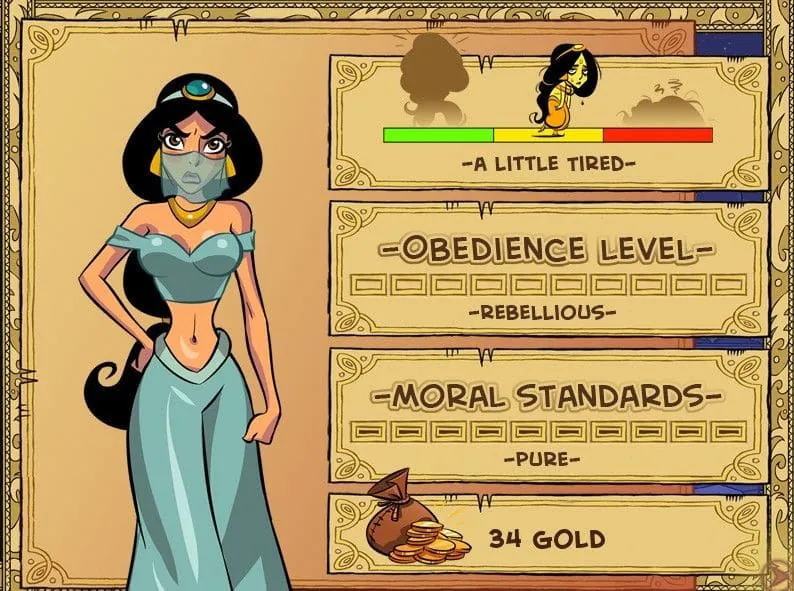
If navigation is the “how,” then character stats progression is the “why.” This is the true RPG heart of the game. The princess (and to some extent, your own character) has key attributes that act as gates, keys, and measuring sticks for the entire story. 📊🔑
The primary stats you’ll be managing are things like Intelligence, Obedience, Refinement, and Corruption. These aren’t just numbers that go up; they are direct prerequisites for story scenes, dialogue options, and training activities. For example, trying to teach the princess a complex historical lesson will fail if her Intelligence is too low. Want her to wear a certain outfit? Better check that Obedience score first.
Here’s the golden rule I learned the hard way: balanced growth is often better than min-maxing one stat. In one playthrough, I pumped Obedience sky-high but neglected Intelligence. I hit a wall where entire story branches and quests were locked away because she wasn’t “smart” enough to understand certain situations. The game constantly checks these values behind the scenes. This system of character stats progression means every training action—be it a lecture, an chore, or a gift—is an investment in future possibilities.
Managing this system is your core loop. You check a stat, see what you want to unlock, and then plan your daily actions to raise the required attribute. It’s a fantastic feedback loop that makes even small stat gains feel meaningful. Watching a number tick up isn’t the reward; the reward is the new “Yes, you may” dialogue option that appears where there was once only a frustrating “She doesn’t understand…”
Daily Time Management and Strategic Planning
This is where the rubber meets the road. All the navigation and stat planning mean nothing without mastering the daily cycle time management. Your day is split into three distinct segments: Morning, Afternoon, and Evening. Each segment is a single, consumable resource—once you use it for an action, it’s gone. This creates a constant, delightful tension. ⏳⚖️
Do you spend the morning working a job to earn dinars, or training the princess’s stats? Do you use the afternoon to explore a new location for story events, or to shop for crucial items? The evening might be your only chance to trigger certain private conversations. You can’t do it all in one day, and you can’t do it all in one playthrough. This daily cycle time management is the game’s way of forcing you to specialize and make meaningful choices that define your unique story path.
My personal “aha!” moment came when I stopped seeing days as individual units and started planning in weekly blocks. For example: “This week, my goal is to unlock the library advanced studies. That requires 40 Intelligence. I’ll dedicate mornings to intelligence training, afternoons to a high-paying job for book money, and evenings to raising affection so she’s receptive.” This macro-view of strategic planning transforms the game from a reactive click-fest into a purposeful simulation.
Now, let’s visualize how these major systems interconnect to form the game’s core. 🎮
| Feature | Mechanic | Player Impact |
|---|---|---|
| Daily Cycle | Day divided into 3 actionable segments (Morning, Afternoon, Evening). | Forces strategic prioritization. You must choose between income, training, story progression, and relationship building every single day. |
| Character Stats | Attributes like Intelligence and Obedience are raised through specific actions and act as progression gates. | Directly controls access to story content, dialogue, and quests. Your training focus shapes the entire narrative path. |
| Relationship System | A hidden “affection” value influenced by dialogue choices, gifts, and events. | Unlocks private scenes, makes the princess more receptive to training, and opens exclusive story branches. |
| Inventory Economy | Earn Dinars from jobs/events; spend on items, clothing, and training tools. | Financial limits drive decision-making. Better gear and gifts require savvy resource management and job selection. |
The Symphony of Systems: Relationships, Economy, and Dialogue
Understanding the individual parts is one thing, but the magic of Princess Trainer Gold Edition is how these systems sing together. Let’s talk about the glue that holds it all: the relationship system affection, inventory economy dinars, and dialogue choices story branches.
The relationship system affection is a hidden metric, but its effects are everywhere. Raising affection isn’t just about being nice; it’s a practical strategy. A princess with higher affection gains stats more efficiently from training and becomes open to more advanced, story-altering interactions. You raise it through a combination of successful training, giving the right gifts (which costs dinars), and, most crucially, through dialogue choices story branches.
Every conversation is a potential pivot point. A single, seemingly innocent dialogue choice can:
* Raise or lower hidden affection.
* Increase a stat like Refinement or Corruption.
* Unlock an entirely new quest or location on your map.
* Award you a special item or a lump sum of dinars.
This is where your strategic planning gets tested. Your financial state (how many dinars you have) dictates what gifts you can buy to boost affection. Your affection level unlocks new dialogue options. And those new dialogue choices can lead to rewards that solve your financial problems or stat blocks. It’s a magnificent, interconnected web.
Pro Tip: Don’t just spam the same “nice” dialogue option. Pay attention to the princess’s mood and your current stats. Sometimes, a stricter choice can raise Obedience, which is more valuable in the long run than a tiny affection bump. It’s all about your end goal!
Let’s walk through a practical example to see this cascade in action:
Scenario: You’ve been focusing on the princess’s Intelligence and have a modest amount of dinars saved. During an afternoon story event in the palace, a new dialogue choice appears: “Suggest she studies the kingdom’s trade ledgers.”
- Choice Made: You select it. The game checks your Intelligence stat (which is high enough) and your affection level (moderate).
- Immediate Result: The scene plays out. +1 to Intelligence, a small boost to affection for showing interest in her duties, and the princess remarks on a financial discrepancy in the ledger.
- Branch Unlocked: This triggers a new, optional side quest: “Investigate the Market Shortfall.”
- New Location/Mechanic: The quest prompts you to spend time at the Market during a morning segment to investigate.
- Financial & Story Payoff: Completing this investigation quest rewards you with a large sum of dinars (boosting your inventory economy) and unlocks a new, permanent high-paying job option at the Merchant’s Guild. It also raises Obedience as the princess follows your investigative instructions.
- The Cascade: Now, with more dinars, you can afford better training tools and luxury gifts. The higher Obedience unlocks new training activities. The whole game has expanded because of one informed dialogue choice.
This is the core gameplay loop of Princess Trainer Gold Edition. It’s not a series of isolated minigames. It’s a deep, reactive simulation where your management of daily cycle time management, focus on character stats progression, and careful navigation of dialogue choices story branches all combine to create a story that is uniquely yours. Master these Princess Trainer Gold Edition mechanics, and you move from being a passive observer to the master strategist behind the throne. 👑➡️🎯
Princess Trainer Gold Edition delivers a sophisticated blend of simulation and strategy that rewards careful planning and meaningful decision-making. By mastering the daily time management system, understanding how character stats gate progression, and leveraging the relationship mechanics, you unlock the full depth of what this game offers. The interconnected systems create a living world where your choices genuinely matter, leading to multiple story outcomes and unique experiences. Whether you’re pursuing specific character arcs, completing all available quests, or discovering hidden story branches, the foundation lies in understanding these core mechanics. Take time to experiment with different approaches, pay attention to how your decisions ripple through the game world, and enjoy the rich narrative possibilities that unfold as you progress through this immersive simulation experience.